|
Features and benefits |
Oil, engine, Plus-50™ II 0W-40,15W-40 and 10W-30
|
Plus-50™ II Engine Oils |
|
Index |
|
· Products · Plus-50™ II Premium Engine Oil (15W-40, and 10W-30) · Plus-50™ II Premium Synthetic Engine Oil (5W-40) · Plus-50™ II Premium Synthetic Engine Oil (0W-40) · Product Availability and Order Information · Features, tests, ratings, and charts · Chemical and physical properties (15W-40, 5W-40, 10W30 and 0W-40) · Performance level comparison · Warranty · Plus-50™ II and Hy-Gard oils price comparison worksheet · Plus-50™II FAQs |
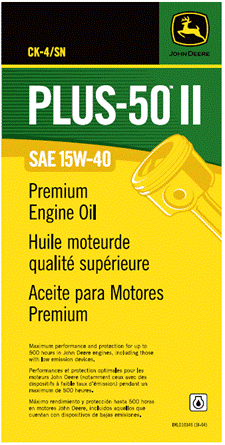
Plus-50™ II Premium Engine OilPlus-50 II Premium Engine Oil has been developed to meet the needs of John Deere engines, both modern and heritage. It is recommended for all 4-stroke naturally aspirated, turbocharged, and supercharged diesel engines, including those with Diesel Particulate Filter (DPF), Selective Catalytic Reduction (SCR), Diesel Oxidation Catalyst (DOC), and Exhaust Gas Recirculation (EGR). Examples of applications include heavy-duty off-road equipment, on-road trucks, 4-cycle marine engines, natural gas engines, pickups, and automobiles.
Plus-50 II is an exclusive John Deere formula that exceeds current industry requirements and is highly recommended for use in all engines requiring oil with API service categories of CK-4, CJ-4, CI-4 PLUS, CI-4, and CH-4, as well as SN, SM, SL, and SJ.
Low sulphated, ash, phosphorous and sulfur (SAPS) engine oils, such as Plus-50 II (CK-4), must be used with Interim Tier 4 and Tier 4 engines or significantly reduced DPF life will result.
|
|
|
The proven performance along with extensive field testing, allows extended drain intervals up to 500 hours when using Plus-50 II and John Deere filters for your John Deere engine. Refer to the Operator’s Manual to validate the recommended change interval for your specific machine. |

Features and benefits– Superior protection for current and older engines. – Extended drain intervals up to 500 hours when using Plus-50 II and John Deere filters and Ultra Low Sulfur Diesel (ULSD) fuel in a John Deere engine. † – Formulated specifically to inhibit wear, corrosion, sludge, varnish, and oxidation. – Delivers excellent low-temperature performance. – Proven performance in low-emission engines. – Full-fleet solution. – Unsurpassed performance in internal extreme/severe John Deere engine oil requirements dyno test. – Excels in delaying oxidation in high heat, heavy-duty operations. – Compatible with biodiesel fuels and qualified with B20 biodiesel blend.
† Note: We strongly recommend that all John Deere engines use Plus-50 II oil to ensure optimal performance, including extended drain-interval options. Review the service-interval recommendations for each type of engine as described in the next section. - |
|
· Chemical and physical properties · Performance level comparison
|
Service IntervalsOil and filter service intervals in John Deere diesel engines are based on a combination of factors, including:
1. The type of engine oil and filter in the application. 2. The sulfur content of the diesel fuel. 3. The volume of oil in the system. 4. The power output of the engine.
We recommend changing the oil and oil filter at least once every 12 months, even if the hours of operation are fewer than the otherwise recommended service interval. |
Service Intervals for John Deere Tier 4 Emission Certified and Older Diesel EnginesOperators using John Deere Tier 4 emission-certified and older diesel engines may now utilize 500-hour oil and filter service intervals beyond what is published in the Operator’s Manual when all of the following conditions are met: 1. John Deere Plus-50 II and John Deere filters are used. 2. Use of Ultra Low Sulfur Diesel (ULSD) fuel with a sulfur content less than 0.0015% (15 mg/kg or 15 ppm) is required.
Refer to the Operator’s Manual for the equipment/engine for the engine-oil and filter service recommendations.
Service intervals for John Deere Tier 4 emission-certified diesel engines:Operators must follow the engine-oil and filter service interval recommendations in the Operator’s Manual.
These engines are designed to deliver power while operating at a reduced emission level. They must use diesel fuel with 15 ppm or less sulfur (ULSD) and diesel engine oil rated at API CK-4, CJ-4, ACEA E9, or ACEA E6 to remain in compliance with emission regulations. Use of other specification fuel or oils in Interim Tier 4 and Tier 4 engines can result in emission noncompliance and premature DPF service requirements. John Deere Plus-50 II is the product recommended for these applications and the only product(b) approved for extended service intervals in John Deere diesel engines.
(a) This 500-hour service interval is now possible in John Deere Tier 4 emission certified and older diesel engines because of two favorable factors: At the time when these engines were placed into service, operating conditions regarding oil class and fuel types were different. Engines beginning service in the U.S. before the 1990s were operating with API CE or lower service class oils. The diesel fuel for on-road applications was at 5,000-ppm sulfur, with off-road up to 10,000 ppm. Environmental concerns and industry regulations have driven improvements to the oil types available, as well as significant reductions in the sulfur level of diesel fuel. John Deere Plus-50 II is designed for performance through longer service intervals, handling the heat and contaminants of combustion, while maintaining viscosity, lubricity, detergency, dispersants, and acid-buffering properties. Diesel fuel sulfur levels have been reduced from as much as 10,000 ppm to the current 15 ppm, equating to the elimination of over 99.5% sulfur. These converging factors deliver the achievement of 500-hour service intervals with the oil system capacity already designed into existing John Deere Tier 3 emission-certified and older diesel engines.
(b) Break-In™ Plus is also recommended for and supports an initial oil-service interval equal to that of Plus-50 II.
|
||||||
|
||||||
|
|
||||||

Product Availability & Order Information

Bulk Oil DecalsBulk oil tank decals are available to order. |
|
|
|

Bulk Oil Decal Order Information
|
Part |
|
Pkg.qty. |
|
DKLD1034S |
Decal, Plus-50™ II 15W-40 Bulk Oil, small |
5 |
|
DKLD1034L |
Decal, Plus-50™ II 15W-40 Bulk Oil, large |
1 |
|
DKLD1037S |
Decal, Plus-50™ II 10W-30 Bulk Oil, small |
5 |
Plus 50™ II Premium Synthetic Engine Oil (0W-40)
Plus-50 II Premium Synthetic Engine Oil 0W-40 is excellent for all climates; however,
it was specifically developed for customers who operate equipment in extremely cold conditions
and want to maximize engine life and performance.


Meets Service Classifications |
|
|
API (diesel): |
CK-4, CI-4 Plus, CI-4, and CH-4, |
|
API (gasoline): |
SN, SM, SL, SJ |
|
Mack: |
EO-N Premium Plus 03, EO-M Plus |
|
Cummins: |
CES20081, 20078, 20075 |
|
Mercedes Benz |
228.31 |
|
Military: |
CIDA-A-52306 |
|
|
|
Air temperature chartDetermine oil viscosity based on the expected air-temperature range during the period between oil changes.
PMB10108 |

Performance level comparisonOil is not just oil. There is a difference between high performance oils and oils that just meet the minimum industry requirements: – Universal competitive oils in the marketplace only have to meet minimum performance levels set by the API. Using minimum-level oils will result in reduced performance and shorter engine life. – John Deere Plus-50™ II Premium Engine Oil exceeds all industry requirements and meets the high standards set by John Deere engineers. – John Deere Plus-50 II Premium Engine Oil is developed to give the maximum engine protection and the longest life possible.
During the course of oil development and qualification, we test the oil under extreme conditions using a specially developed engine test: – This test was developed by John Deere as a standardized test. It is the most severe diesel engine test in the industry for lubricant thermal-oxidation. – It involves running a John Deere engine for hundreds of continuous hours, without oil top-up under extreme test conditions. – The objective of the test is to ensure the oil can survive the severest conditions our engines may experience, including piston deposits, wear, and oil oxidation over the service life of the oil. – This is the primary engine oil test used by John Deere to determine how well an oil will perform in heavy-duty, off-road applications.
Review our Lubricants Sales Guide for additional information on performance and engine testing.
|
Warranty |
|
John Deere Plus-50™ II Engine Oil |
|
Limited Performance Warranty |
|
John Deere guarantees Plus-50 II Engine Oil will meet or exceed the performance needs of diesel engines. Regardless of hours or miles, John Deere will pay for any damages (parts and labor) to your engine which are caused by a Plus-50 II oil defect so long as: – The oil defect is verified by oil analysis. – The engine oil used is confirmed to be unadulterated and non-contaminated Plus-50™ II. – Plus-50 II meets the engine manufacturer’s specifications for the service and application. – The engine is used under normal operating conditions and maintained according to manufacturer’s recommendations.
To secure warranty service, report the product failure to an authorized John Deere dealer.
To make a claim under this warranty, it will be necessary to provide the following as part of the technical investigation: – Records showing that the engine was serviced according to the manufacturer’s recommendations. – Submit the used Plus-50 II, along with detailed information of machine and fluid hours, dates, and an oil sample from the failed engine for analysis to determine if oil is defective. – Make the failed engine available.
John Deere disclaims all liability for indirect or consequential damages.
Your rights and remedies pertaining to this warranty are limited as set forth herein. Implied warranties of merchantability and fitness are not made and are excluded.
Further details can be found in our Warranty Brochure (hyperlink needed). |
|
|
Plus-50™ II Question & AnswersQ. Is John Deere oil a re-brand of standard shelf oil? A. Plus-50™ II is a unique engine oil, developed by John Deere engineers and exclusive to John Deere dealers.
Q. What makes Plus-50 II the best? A. Features and benefits include: – Reduces wear. – Resists increases in oil viscosity. – Gives better oxidation control. – Fights against varnish and sludge deposits. – Cost savings: Less downtime, maintenance, and labor costs, and extended drain intervals (when used with John Deere filters). – Compared to other oils, it has greater thermal stability, a lower rate of viscosity thickening, better soot control, and better wear protection.
In summary, Plus-50 II was not developed to just meet a minimum API performance standard. It was developed to provide the ultimate protection and premium performance for John Deere engines in John Deere machines. It is a premium, heavy-duty engine oil, not just a generic-brand oil that meets minimum API standards. Documented test results from our field machines and lab engines support its superior-performance claims. - |
|
· Q. How does Plus-50 II compare to other oils? · · A. Compared to other oils, Plus-50 II has: · – Greater thermal stability, lower rate of viscosity thickening, and less degradation than with competitive oil. · – Longer oil life with sustained performance and drain intervals increased 100% over Operator's Manual · recommendation when used in John Deere engines with John Deere filters and Ultra Low Sulfur Diesel (ULSD). · – Increased engine durability, and less abrasive and corrosive wear than with competitive oils. · – Cleaner engine and less piston deposits than with competitive oils. · – High initial alkalinity and good reserve at the end of recommended drain interval, allowing continued acid protection. · – Excellent low-temperature fluidity. |
|
Q. Do Torq-Gard™ and Plus-50 II have the same base oil? A. The same type of high-quality base oil blends are used in all John Deere lubricants.
Q. Where can Plus-50 II engine oil be used? A. Primarily designed for off-highway, heavy-duty diesel engines, Plus-50 II oil also gives excellent performance in on-highway, heavy-duty diesel applications. – All diesel engines requiring SAE 15W-40 and API CK-4 classification oil. Plus-50 II is also available in SAE 10W-30, 5W-40 and 0W-40.
Q. Are there any applications where Plus-50 II should not be used (such as irrigation engines or power units)? A. Some engine manufacturers have oil recommendations that specify a unique product for an application. For example, 2-cycle Detroit Diesel recommends an ash level below 1.0% and a straight SAE 40 viscosity grade. Some engines designed for natural-gas or liquid-propane fuels commonly recommend that ash levels be held below 0.5%.
– Plus-50 II should not be used for initial fill in new or rebuilt engines. John Deere Break-In™ Plus oil is available for this purpose.
Check the Operator's Manual for oil recommendations before making any changes in engine oil type.
Q. What is the advantage to a customer who intends to continue changing oil at 100-hour intervals? A. Use of Plus-50 II is added insurance. With Plus-50 II, the engine will run cleaner, with less wear and more power, even if used for only 100 hours.
Q. The customer states, “I’ve used co-op oil for 12 years and never had a problem. Why should I change to Plus-50 II?” A. This depends on the customer’s definition of a “problem”: – If Plus-50 II is used, the customer will have a cleaner engine, more power, and less wear. – It is not a matter of avoiding catastrophic failure, but rather a matter of better performance and the extended life of the engine.
Q. Can I put 2018 oils into 1960 machines? A. Operator's Manuals are to be used as the guideline in all cases. As a note, older manuals will not recognize any advances of technology occurring after the product was introduced.
– John Deere-marketed lubricants take into consideration older-model units and the recommendations for the use of these lubricants in those units. – Plus-50 II is recommended for use in all John Deere diesel engines and may be used in older John Deere and competitive engines recommending the use of API performance grades CH-4, CI-4, CI-4 PLUS, CJ-4, and CK-4. – In general, older (lower alphabetical designations) API performance designations can be replaced with newer (higher alphabetical designations) API performance levels without affecting engine performance. – Performance and longevity are usually improved by this switchover.
Q. Will changing my brands of oil cause my engine to consume oil differently? A. When upgrading to Plus-50 II oils following the use of other oils, little differences in oil-consumption rate should be expected. A small percentage of engines may experience a noticeable change in oil-consumption rates.
– Those engines experiencing decreased oil consumption should require no further attention.
Normally no increase in consumption will be observed. However, if it does occur, it may be due to one of the following factors: – The previously used oil product may have built up deposits on internal components. – Introducing a premium-performance oil with different additive systems which contain additional detergents, dispersants, anti-wear characteristics, and antioxidants that may cause different chemical reactions to occur in the deposits already established.
The time required for the engine to regain previously observed oil-consumption rates with the new oil may vary from one to three normal drain intervals. This phenomenon is not unique to John Deere engines and oils but is commonly reported for competitive engines when switching to competitive oils.
Q. What specifically shows Plus-50 II is better than other oils? A. Plus-50 II is evaluated using a special high-temperature engine test, which is beyond what is required for API rating. This is a severe test of the oil’s resistance to oxidation and thickening. It is also a severe test of the oil’s ability to keep the pistons clean.
Q. After I bought several pails of Plus-50 II oil, I found a few gallons of Torq-Gard. Can I mix the two until I’ve used up the Torq-Gard? A. While the two oils are compatible and mixing of the two John Deere oil formulations is acceptable, mixing should not be done on an extended basis.
– Mixing with Plus-50 II should be limited to short-term topping-off situations only. – When mixing these oils, the extended-drain feature of Plus-50 II would not be applicable.
Q. I changed my oil inventory from Torq-Gard™ SAE 30 to Plus-50™ II SAE 15W-40. Now I need to top off the oil prior to an oil change. Can I add Plus-50 II 15W-40 to the SAE 30 in my engine? A. Yes, a one-time mix of the two formulations and viscosities is allowed; however, mixing is not recommended as an ongoing practice or during extreme conditions such as cold weather or continuous high loads.
Q. Can I change from SAE 30 to 15W-40 oil in my John Deere engine? A. Yes. See below for further details: – In older equipment Operator's Manuals, SAE 30 is recommended. – Due to the improved additives in multi-grade oil, we now prefer customers use 15W-40 oil. – The customer now has the option to select the oil that best meets his equipment’s operating conditions.
Q. Can I use Plus-50 II oil as a “break-in” oil after rebuilding an engine? A. No, it is not recommended for use as a “break-in” oil. A rebuilt engine must be allowed to properly wear-in the piston rings and the cylinder liner walls during the first 100 hours of operation. Although Plus-50 II has superior lubrication properties, it is recommended you use John Deere’s Break-In™ Plus Special-Purpose Engine Oil.
Q. What causes the engine not to break in during the first 100 to 500 hours? A. One main factor that will delay an engine’s break-in time is operating the engine under less than high-load conditions (pulling a trailer, baler, or lighter load) as this may not provide enough loaded piston action to cause ring and liner seating.
Another factor that may interrupt the break-in process is the introduction of a premium lubricant, like Plus-50 II, prior to the completion of the break-in process. To ensure there is no delay, we recommend the operator run the engine under high-load conditions and at various engine speeds during the break-in period.
Q. Can I use Plus-50 II oil when an API classification of CF-2 is required? A. No, API CF-2 classification is for 2-cycle diesel engines only. Oil used in these types of engines normally require a low ash content of less than 1% and single-viscosity oil. Since Plus-50™ II is a multi-viscosity oil, it is not recommended as it doesn’t meet both requirements noted (less than 1% ash and single viscosity).
Q. I use Torq-Gard SAE 10W oil in the winter and Torq-Gard SAE 30 in the summer. Can I use Plus-50 II 15W-40 oil year-round instead of changing oil grades seasonally? A. Yes, Plus-50 II SAE 15W-40 can be used year-round. That would eliminate the possibility of having the wrong viscosity oil in the crankcase if an unseasonal hot or cold spell should occur. For the ultimate in cold-temperature stability, cold-flow ability, and quick lubrication, consider using Plus-50 II SAE 0W-40 full synthetic formula. (Check your Operator's Manual for the proper low-temperature range.)
Q. Should I use Plus-50 II in a new tractor? A. Yes, it is the recommended oil for John Deere engines after the break-in period. As a reminder, for the first 100 hours (minimum), John Deere recommends Break-In Plus engine oil.
Q. What oil is in new John Deere engines? A. New John Deere engine-powered equipment is shipped with our special-purpose Break-In™ Plus oil. If additional oil is needed during the normal break-in period, use John Deere Break-In Plus, oil for top-off. Do not add oil prior to the oil level dropping to the add mark on the dipstick.
Q. Can I go 500 hours with Plus-50 II (CK-4 / E9) in a Tier 4 or older engine? A. Yes, when all of the following conditions are met: – John Deere Plus-50 II and John Deere filters are used. – Use of Ultra Low Sulfur Diesel (ULSD) fuel with a sulfur content less than 0.0015% (15 mg/kg or 15 ppm) is required. – The original-volume oil pan (or larger) that was delivered with the engine is still in use, and the oil level is maintained at normal volumes through the service interval. – The engine is operating within the original factory specifications affecting power output, including engine control units (ECUs) and fuel-delivery systems.
This is possible in John Deere Tier 3 emission-certified and older diesel engines because the original oil-sump capacity aligned with using higher sulfur level diesel fuel as written in the original Operator’s Manuals. We recommend changing the oil and oil filter at least once every 12 months, even if the hours of operation are fewer than the otherwise recommended service interval.
Q What impact does using biodiesel have on my engine oil service interval when I am using Plus-50 II? - IS THIS STILL TRUE?? John Deere Power Systems has a strong commitment to the environment, energy security, and technological advances that have a positive impact on both.
Biodiesel certainly meets these criteria. While B5 blends are preferred, biodiesel concentrations up to 20 percent (B20) blended in petroleum diesel fuel can be used in all John Deere engines, providing the biodiesel used in the fuel blend meets the standards set by the American Society of Testing Materials (ASTM) D6751.
Extensive testing was performed with B20 in the development of Plus-50 II. Due to variations in the quality of feed stock used in biodiesel production and the lack of testing by other engine oil manufacturers, we provide the following oil service interval modifications when using biodiesel fuel blends: ULSD (B0) to B30 no change in oil service intervals Above B30 50% reduction to oil service interval*
*Service intervals could be extended through the use of oil analysis
Follow this link for more information about using biodiesel fuel in John Deere engines: https://www.deere.com/en/engines-and-drivetrain/learn-more/biodiesel/ |
Last modified: 06Jan2021.